Analyst Toolbox: 2. Capital Structure & Time Horizon, and its effects on IRR & MOIC
Understanding and practicing the basics of a private equity investment's benchmarking

Imagine yourself on a PE/VC fund investment committee, where you are pitching an opportunity to invest in a business that has great potential. You succesfully build robust forecast of the business for the upcoming 5 years while also clearly explain it’s main value drivers and performance levers. You finish the last slide, and the Q&A begins - the MDs congratulate you on your analysis, but they have a couple of direct questions regarding the capital structure of the deal, plus the investment horizon - more precisely, they ask you about how these variables affect the expected performance of this potential investment in terms of IRR (Internal Rate of Return) and MOIC (Multiple On Invested Capital).
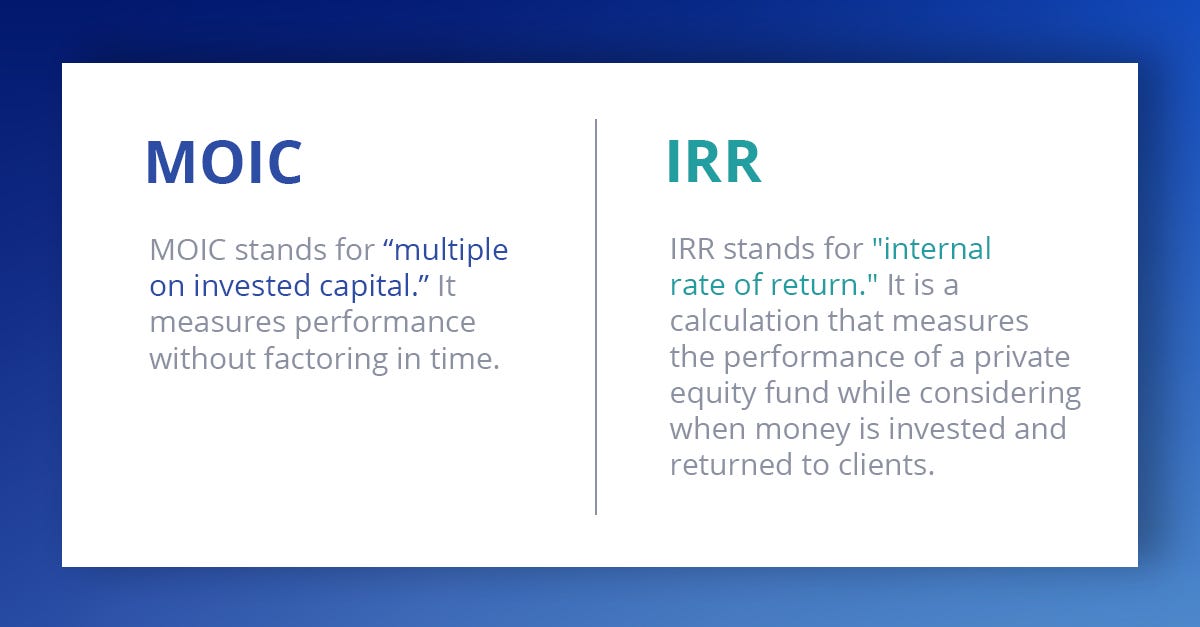
On today’s toolbox, we found ourselves with a simple-to-use template that helps us understand the effects of leverage and investment horizon on an equity return for a PE firm, in terms of IRR and MOIC (let the reader know that, as the Finance 101 non-written handbook establishes, NPV rules over these two indicators, but these two are more commonly used in the industry, given their ease-of-use and straightforward estimation)
Here is some additional literature to deep-dive into this topic:
What Is Internal Rate of Return (IRR) And How Is It Calculated?
Internal Rate of Return (IRR): Definition, Formula & Example
The template allows the user to define:
Investment Needs (total needs that the target company is looking to fundraise)
Equity Share: capital share that is funded with equity (resources coming from the equity investment analysts POV), and that implicitly results in a debt share of the capital structure.
Pre-Money valuation of the target opportunity
Debt terms: annual interest rate (compounded monthly) and maturity
Post Money Sales Multiple (in order to define the starting level of sales for the target opportunity)
Equity Exit Month
Outstanding Cash at the moment of the exit (for EV calculation)
Valuation Parameter: either Sales or EBITDA, and their respective multiples.
Sales Growth forecast and EBITDA margin assumptions - the model assumes value is fully realized at the moment of the exit.
In the following link you’ll find a simple template modelling this analysis with easy assumptions, focusing on understanding its structure and effects.
Leverage, MOIC and IRR - Value Quest Template
Feel free to make a copy to further explore on it (also, you’ll need to make a copy to edit it) and let me know if there is any additional iteration you’d like to see.